Dental Implant: Procedure, Cost & Insurance in Hong Kong
Learn about dental implants in Hong Kong, procedure, cost, pros and cons, and insurance coverage. Compare options from top dental clinics.
Reviewed by a licensed advisor

If you are distressed at a missing tooth, dental implants may be a suitable replacement to fill the gap in your smiles, putting you back on track with better oral health. Read our comprehensive guide below to learn more about its pros and cons, procedure and costs before you book a session.
What are dental implants?
Dental implants are composed of three separate parts: implant, abutment and porcelain crown. The actual implant is an artificial tooth root consisting of a screw surgically fused with your jaw to act as a seamless anchor for the crown.
The replacement tooth will be similar to the look and feel of your natural teeth, fitting perfectly into your mouth.
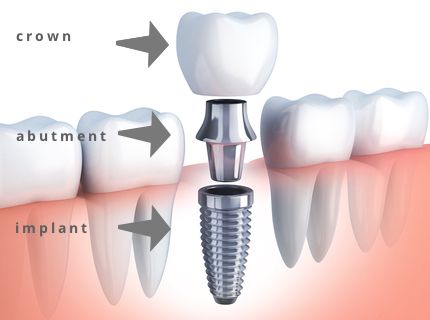
Source: Bowmanville Dental
Dental implants can be used to replace a single tooth, multiple teeth or a full upper and/or lower set of teeth. If you need to restore a full arch, a full mouth treatment is available as well. Surgeons will place four implants before attaching a full arch of teeth.
Are dental implants right for me?
Who should get an implant?
Choosing dental implants may be the right call if you experience tooth loss due to tooth decay, gum disease or injury. You may also consider dental implants for a healthy bite, or improved speaking and chewing ability.
For those who have used traditional dentures but find fixed dentures difficult to clean, or those who are not accustomed to the weak chewing of movable dentures, you may also discuss with your dentist to switch to dental implants.
Contrary to a common misconception, dental implants can work well even with the elderly. Consult your dentist to see if you are a suitable candidate for the surgery.
Who should not get an implant?
You are recommended to inform your dentist in advance for a thorough evaluation before opting for dental implants, especially if you have:
Extremely poor liver and kidney function
Severe uncontrolled diabetes — Note that dental implants is safe to well-controlled diabetic patients
Chronic disease (e.g. severe cardiovascular condition) or have long-term drug use
Immune deficiency
History of chemotherapy and radiation therapy, head and neck cancer
Life habits that are likely to damage teeth (e.g. teeth grinding at night, biting hard food or chewing betel nuts, alcoholism, addiction to tobacco, etc.)
In general, dental implants are not recommended for those under 18 years old whose bones are still growing. Note that dental implants should not be your priority if there is a cure to your tooth problems. You should only consider this option if your natural teeth cannot function normally.
Dental implant vs. denture and bridge
Dental implants are not your only option. However, when it comes to missing teeth, failing teeth or chronic dental problems, dental implants are a more effective solution in the long run compared to dentures and bridges, because they are safe, easy to maintain, and play a crucial role in preventing bone resorption (ongoing jaw bone loss).
For a detailed comparison, we have put together different factors below:
Dental implants | Dentures | Bridges | |
|---|---|---|---|
Last for | A lifetime* | 5-7 years | 7-10 years |
Preserve healthy adjacent teeth? | Yes | Yes | No |
Transmit force to: | Jaw bone | Adjacent teeth/gums | Adjacent teeth |
Prevent bone loss & preserve facial appearance? | Yes | No | No |
Accelerate loss of adjacent teeth? | No | Yes | Yes |
Require periodic adjustments? | No | Yes | Yes |
* Note that the crow usually lasts about 10-15 years before it may need a replacement due to wear and tear)
Before you make your decision, discuss your options with a dentist for a thorough assessment of your oral condition.
What to expect from the first dental session
You can expect a 3D CT scan and professional dental evaluation on your first visit, for the dentist to understand your oral and physical condition before designing a personalized treatment plan with a clear quotation. Any diseases or factors that hinder the long-term stability of the implant should be controlled at this stage before the implant.
Healthy alveolar bone, in particular, is the key to a stable foundation of dental implants. Any deficiency in the alveolar bone calls for a prerequisite bone regeneration.
Dental implant surgery
To implant artificial tooth roots in your jaw bone (right below the gums), a minimally-invasive dental implant surgery lasting about 1-2 hours will be performed. Microscopic techniques can be used to complete the operation causing tiny wounds and minimal post-operative discomfort.
Crown fitting and aftercare
With the implanted metal root placed in your jaw bone, your alveolar bone will slowly heal in 3 months, after which a healing device will be put in place to grow the gums into an ideal shape.
Once the gums are fully healed, the final restoration process comes in. A temporary crown will be placed to form the shape of your new tooth, treatment will be complete after the permanent fixture of a porcelain crown.
Aftercare is important in the following 3-6 months, you are recommended to schedule regular checkup and cleaning appointment with your dentist. Don’t forget to maintain good oral hygiene habits, too.
Options and costs of dental implant in Hong Kong
Dental implant in the public sector
You can find the list of public dental clinics and health centers here. These public dental clinics offer emergency dental service only, limited to pain relief and extraction. Beware of waiting times which can be very long in the public sector.
Dental implant in the private sector
Apart from consultation costs, there are 2 levels to the cost of dental implants:
Dental implant surgery: implant & bones
Crown-making: temporary & permanent implant crown
Note that the cost of dental implants is subject to a variety of factors, such as the techniques, precision and accuracy of the procedure, quality of dental materials and equipment.
It is important that you do your research beforehand and be aware of additional charges during the treatment, such as CT scan charges and dental appliances.
We have summed up some private options in detail for your reference below:
Dental clinic | Address | Consultation fee | Fee per single tooth implant fixture |
|---|---|---|---|
Hong Kong Sanatorium & Hospital | Level 22, One Pacific Place, 88 Queensway Hong Kong | HK$ 1,500 - HK$ 2,500 | Starting from HK$ 45,000 |
Union Hospital Dental Center | 2/F Medical Centre, 18 Fu Kin Street, Tai Wai, Shatin, New Territories | HK$ 1,500 - HK$ 2,000 | Starting from HK$ 40,000 |
The Prince Philip Dental Hospital | 34 Hospital Road, Sai Ying Pun, Hong Kong | HK$ 600 - HK$ 2,500 | HK$ 17,600 - HK$ 35,000 |
St. Paul’s Hospital | 2/F, Block A, 2 Eastern Hospital Rd, Causeway Bay, Hong Kong | HK$ 500 | Starting from HK$ 40,000 |
GS DentoSpot | Suite 801, 8/F, 700 Nathan Road, Mong Kok, Kowloon | HK$ 150 | HK$ 21,000 |
Healthy Smile | Mong Kok: 18/F, Kelly Commercial Centre, 570-572 Nathan Road, Kowloon | Free | Starting from HK$ 22,000 |
Nixon Dental | Room 1136-1137, 11th Floor, One Grand Tower, 639 Nathan Road. Mong Kok, Kowloon | See fees. | The cost of a single implant is HK$ 18,000 |
Penn Pacific Dental Center | Room 601, 6/F, Prosperous Building, 48-52 Des Voeux Road Central, Hong Kong | HK$ 800 | Starting from HK$ 30,000 |
Room 1914, Melbourne Plaza, 33 Queens Road, Central, Hong Kong | HK$ 550 | Starting from HK$ 30,000 - HK$ 40,000 | |
PacifiCare | Pacificare Medical Centre, 12/F and 19/F, 26 Nathan Road, Tsim Sha Tsui, Kowloon, Hong Kong | $500-800 (including oral examination) | HK$ 36,000 |
Dental Implant & Maxillofacial Center (Central) | Room 1901-05, 19/F, The Center, 99 Queen's Road Central, Central, Hong Kong | Starting from HK$ 600 | Starting from HK$ 35,000 |
*All amounts are in HKD and were last updated in December 2021. No responsibility is accepted for any inaccuracies, errors, or omissions. It is always best to call ahead to make sure the information is still up-to-date.
Do dental implants fail?
Manage your expectations well. While dental implants can yield a host of benefits, beware that they can only treat missing teeth and associated complications. The underlying oral health problem will not go away completely. By way of illustration, for patients with periodontal disease, the most pressing concern is to address their oral hygiene or other causes of the gum disease, otherwise the implant is still prone to failure due to periodontal disease.
You should also understand every surgery carries a risk. Complications can range from infections to gum recession and nerve damage.
Are dental implants covered by health insurance in Hong Kong?
Individual or company health insurance may cover dental care but beware of dental limits and co-pay, if any. It is also important to note that certain products divide dental coverage into two categories with different sub-limits: routine dental and major dental. Dental implants generally fall under major dental procedures. Some plans also have a dental waiting period of 3 to 6 months. If you have any medical insurance questions, contact Alea’s health insurance experts at hello@alea.care.
How long does a dental implant procedure take?
Generally speaking, it takes about 4-6 months from the initial diagnosis to the completion of the dental implant, in 3 stages: initial diagnosis, implant roots surgery and the final restoration of the tooth replacement.
How much does a dental implant cost per one tooth?
The average cost of dental implant for a single tooth falls in the minimum range of HK$30,000-40,000 in the private sector. Note that the cost of dental implants is subject to a variety of factors, such as the techniques, precision and accuracy of the procedure, quality of dental materials and equipment. Additional charges may apply during the treatment, such as X-ray charges and dental appliances.
Should I choose dental implants over bridges and dentures?
Dental implants are not your only option. However, when it comes to missing teeth, failing teeth or chronic dental problems, dental implants are a more effective solution in the long run compared to dentures and bridges, because they are safe, easy to maintain, and play a crucial role in preventing bone resorption (ongoing jaw bone loss). Before you make your decision, you should discuss your options with a professional dentist which solution is more suitable for you.

Written by
Julien Mathieu
Co-Founder & CEO | Official CFE Representative


Need some help?
We’re here to provide support and assistance.